Free Consultation | 24/7 Live Answering
(912) 325-7783

If you’ve been hit by a commercial truck in Savannah, the aftermath is overwhelming. These collisions cause catastrophic injuries. Hospital stays stretch into weeks. Surgeries pile up. You may be facing months of rehabilitation before you can return to work—if you can return at all.
And while you’re dealing with all of this, trucking companies and their insurers are already building their defense.
A Savannah, GA truck accident lawyer from Chattahoochee Injury Law can level the playing field. Our firm has spent 13 years representing victims of serious collisions throughout Chatham County, including crashes involving tractor-trailers, delivery trucks, and commercial vehicles of all sizes. We understand how to investigate these cases, preserve critical evidence, and hold negligent trucking companies accountable.
Consultations are free. You pay nothing unless we win your case.
 A Firm That Knows Trucking Litigation
Truck accident cases differ fundamentally from standard auto collisions. They involve federal regulations, multiple potentially liable parties, and aggressive corporate defense teams. Founding Attorney Ben Clary has handled these complex cases for over a decade. He knows what evidence to pursue, which regulations apply, and how to counter the tactics trucking companies use to minimize their exposure.
Ben earned his law degree from Mercer University’s Walter F. George School of Law and holds a Martindale-Hubbell AV Preeminent Rating—the highest distinction for legal ability and ethical standards. He’s also been recognized by Super Lawyers, a peer-reviewed rating service.
When you work with a personal injury lawyer in Savannah at our firm, you get direct access to your attorney throughout the case.
Chattahoochee Injury Law has recovered millions of dollars for clients injured in vehicle collisions. That includes multiple commercial vehicle cases with substantial recoveries. A $5.6 million result in one commercial truck collision. A $750,000 recovery in another. And $415,000 for a client injured in a crash with a commercial vehicle.
These numbers represent real clients whose lives were upended by negligent trucking operations. We fought for full compensation in each case.
Large firms shuffle clients between paralegals and junior associates. That’s not how our firm operates. Ben Clary stays personally involved in every case he takes.
★★★★★
“I called Ben Clary four months before the two year deadline to file my case and he not only took it but also successfully followed through positively on my behalf. I never had to go into the office, had a direct line to him at all times, as well as to his paralegal, Dominic. I highly recommend Attorney Clary to anyone who is looking for justifiable monetary retribution for their automobile accidents, or any other injury that must be settled through legal representation. It was great to have an attorney who not only personally answered my calls but was personable and concerned about my mental and physical wellbeing.” — Dr. Carolyn TurleyMoore
Read more client experiences on our Google Business Profile.
Truck accident victims shouldn’t have to worry about legal fees while they’re recovering from serious injuries. We work on contingency—meaning you owe us nothing unless we recover compensation for you. This allows injured people to access quality representation regardless of their current financial situation.
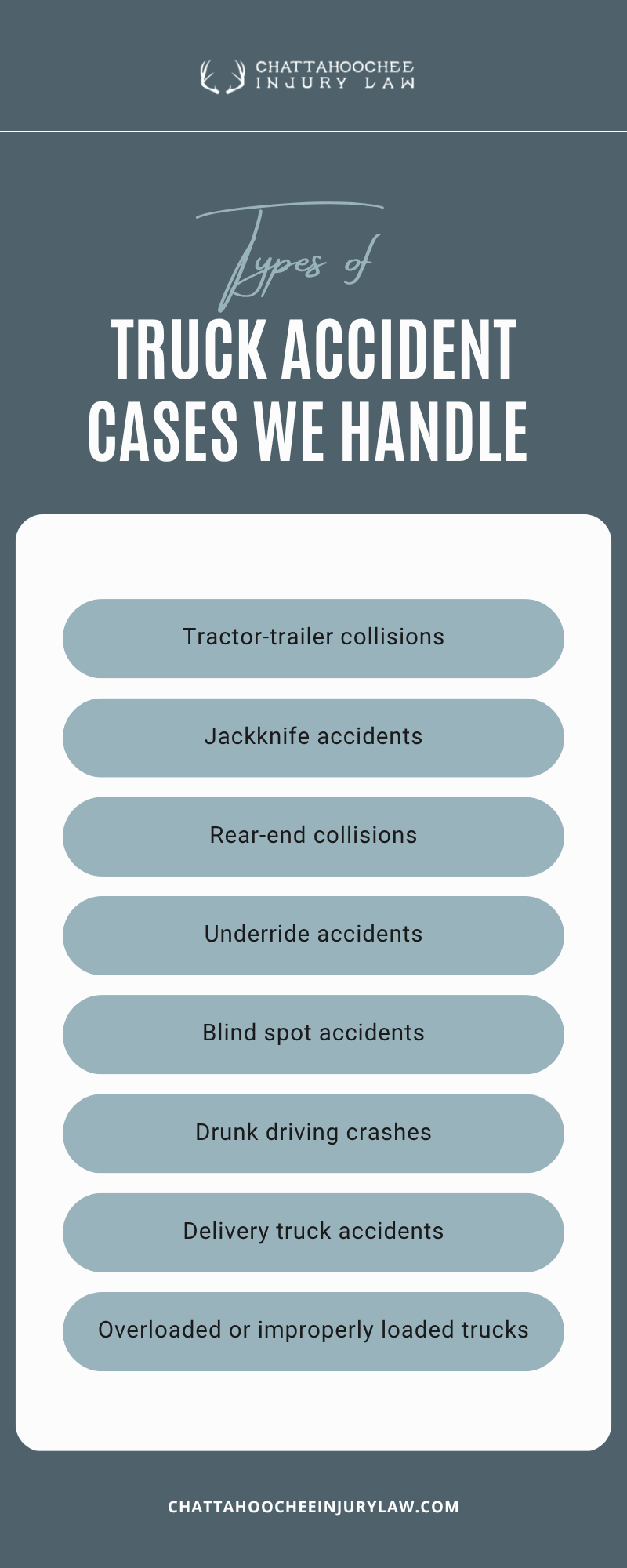
 Commercial trucking encompasses a wide range of vehicles and scenarios. The specific circumstances of your crash affect how we investigate, who bears liability, and what evidence matters most. We handle these personal injury cases involving commercial trucks:
 Truck accidents involve both state and federal regulations. Understanding these rules helps explain who may be liable and what standards apply.
Georgia follows a fault-based system for motor vehicle accidents. The party whose negligence caused the crash bears financial responsibility for resulting damages. Under O.C.G.A. § 51-12-33, Georgia applies modified comparative negligence. If you’re partially at fault, your recovery gets reduced proportionally. But if your fault reaches 50% or more, you recover nothing.
The Federal Motor Carrier Safety Administration regulates commercial trucking operations that cross state lines. These regulations establish:
Violations of FMCSA regulations can establish negligence in a truck accident case. We obtain driver logs, inspection records, and maintenance histories to identify regulatory breaches.
Georgia’s statute of limitations for personal injury claims is two years from the accident date, per O.C.G.A. § 9-3-33. This deadline applies to lawsuits against truck drivers and trucking companies alike.
 Truck collision victims in Georgia can pursue three categories of damages. The severity of injuries in these crashes often means substantial compensation is warranted.
These damages compensate for measurable financial losses. Medical expenses lead the list: emergency treatment, surgeries, hospitalization, physical therapy, rehabilitation, prescription medications, and future care for permanent injuries.
Truck accidents frequently cause traumatic brain injuries, spinal cord damage, and other catastrophic harm requiring ongoing medical attention. The lifetime cost of treating a severe spinal cord injury can exceed $1 million according to the National Spinal Cord Injury Statistical Center.
Lost wages cover income you missed during recovery. Lost earning capacity applies when injuries prevent you from returning to your previous occupation or reduce your ability to earn at prior levels. Property damage covers your vehicle and any personal belongings destroyed in the crash.
Some losses don’t come with invoices. Pain and suffering compensation accounts for physical discomfort, emotional distress, anxiety, depression, loss of enjoyment of life, and diminished quality of relationships. Georgia doesn’t cap non-economic damages in most personal injury cases.
The value of these damages depends heavily on injury severity and how the collision has affected your daily existence. Someone paralyzed in a truck crash faces a fundamentally different life than someone with soft tissue injuries.
When a truck driver or trucking company acted with willful disregard for safety, Georgia law permits punitive damages. These damages punish egregious conduct and deter others from similar behavior. Drunk driving, falsified log books, and knowingly dispatching an unsafe vehicle can all support punitive claims.
Under O.C.G.A. § 51-12-5.1, punitive damages are generally capped at $250,000 with exceptions for particularly egregious conduct.
 What you do immediately following a truck collision affects both your health and your legal claim. Some evidence disappears quickly if not preserved.
1. Get to safety if possible. If you can move and it’s safe to do so, get yourself away from traffic. Truck accident scenes are hazardous for everyone present.
2. Call 911 immediately. Report the crash to law enforcement. Truck accidents require thorough investigation. Officers will document the scene, collect statements, and note observable violations.
3. Seek medical attention. Even if you feel okay initially, get examined. Adrenaline masks pain. Internal injuries and brain trauma may not present immediate symptoms. Medical records also establish the connection between the crash and your injuries.
4. Document everything at the scene. Photograph the truck, your vehicle, road conditions, skid marks, traffic signals, and your visible injuries. Capture the truck’s DOT number, license plate, and any company markings.
5. Get the driver’s information. Obtain the truck driver’s name, employer, insurance information, and CDL number. Request the trucking company’s name and contact information.
6. Identify witnesses. Bystanders who saw the crash can provide crucial testimony. Get names and phone numbers before they leave the scene.
7. Don’t give recorded statements. Trucking company representatives and their insurers will contact you quickly. Do not provide recorded statements without consulting an attorney. Anything you say can be used against you.
8. Preserve evidence. Keep all medical records, bills, pay stubs showing missed work, and receipts for accident-related expenses. Don’t repair or dispose of your damaged vehicle without documentation.
9. Stay off social media. Insurance investigators monitor social media for posts that contradict injury claims. Even innocent photos can be misinterpreted.
10. Contact a Savannah truck accident attorney. Trucking companies dispatch investigation teams immediately after crashes. You need legal representation that can act just as quickly to preserve evidence and protect your rights. Victims of drunk driving crashes face similar urgency around evidence preservation and avoiding recorded statements to insurers.
 The data on commercial truck crashes reveals why these collisions cause such devastating consequences.
According to the Federal Motor Carrier Safety Administration, large trucks were involved in approximately 5,700 fatal crashes nationwide in a recent year. That number represents a significant increase over the prior decade. Georgia consistently ranks among the top ten states for truck accident fatalities.
The National Highway Traffic Safety Administration reports that occupants of passenger vehicles account for the vast majority of deaths in two-vehicle crashes involving large trucks. The weight disparity explains this outcome. A fully loaded tractor-trailer can weigh 80,000 pounds. A typical passenger car weighs around 4,000 pounds.
Savannah’s position as a logistics hub contributes to local truck traffic volume. The Georgia Ports Authority operates the Port of Savannah—the fourth-largest container port in the United States. Container ships arrive constantly. Trucks haul freight to and from the port around the clock.
Interstate 95 runs directly through the Savannah metropolitan area, carrying heavy commercial traffic between Florida and the Northeast. Interstate 16 connects Savannah to Macon and Atlanta, serving as another major trucking corridor.
The Insurance Institute for Highway Safety notes that stopping distance for loaded tractor-trailers is significantly greater than for passenger vehicles. At highway speeds, a commercial truck needs roughly 40% more distance to stop than a car. This physics reality contributes to rear-end collisions when traffic slows unexpectedly.
Driver fatigue remains a persistent problem despite hours-of-service regulations. The pressure to meet delivery deadlines pushes some drivers—and some companies—to violate rest requirements.
 How Is A Truck Accident Case Different From A Car Accident Case?
Truck cases involve federal regulations, multiple liable parties, and typically more severe injuries. Trucking companies carry larger insurance policies—often $1 million or more—but also employ aggressive legal teams. Evidence preservation is more complex, involving electronic logs, black box data, and maintenance records. A standard car accident claim follows simpler procedures with fewer potential defendants.
Potentially several parties: the truck driver, the trucking company, cargo loaders, vehicle manufacturers, and maintenance providers. Our investigation identifies all responsible parties to maximize your recovery.
We handle truck accident cases on contingency. You pay no upfront fees. Our fee comes from a percentage of your recovery—if there’s no recovery, you owe us nothing.
Electronic logging device data, driver qualification files, drug and alcohol testing records, maintenance logs, cargo manifests, and black box information. This evidence can disappear quickly if not preserved through legal action.
Two years from the accident date for personal injury claims. However, evidence preservation requires immediate action. Trucking companies may destroy logs and data after regulatory retention periods expire.
No. Adjusters work for the trucking company’s interests, not yours. They’re trained to obtain statements that minimize the company’s liability. Speak with an attorney before providing any recorded statements.
Trucking companies sometimes claim drivers are independent contractors to avoid liability. We investigate the actual relationship between driver and company. Many so-called independent contractors are legally employees based on the control the company exercises.
Yes. Georgia allows wrongful death claims when negligence causes fatal injuries. Surviving spouses, children, and parents of the deceased may pursue compensation.
Georgia’s modified comparative negligence rule reduces your compensation by your percentage of fault. If you’re found less than 50% responsible, you can still recover damages—just reduced proportionally.
It varies. Simple cases with clear liability might settle within several months. Complex cases involving multiple defendants, disputed liability, or severe injuries can take a year or longer. Cases that go to trial take even longer.
Commercial trucks contain electronic control modules that record data similar to airplane black boxes. This information includes speed, braking, engine performance, and sometimes GPS location. It’s critical evidence that trucking companies may overwrite if not preserved promptly.
FMCSA regulations apply to commercial vehicles operating in interstate commerce. Some local delivery trucks may fall outside federal jurisdiction but remain subject to Georgia state regulations.
Courts can impose sanctions for evidence destruction, including adverse inference instructions that allow juries to assume destroyed evidence would have been harmful to the trucking company. We act quickly to send preservation letters that establish legal obligations to retain evidence.
Yes, but Georgia’s seatbelt defense may reduce your recovery if the defendant proves your injuries would have been less severe with proper restraint. This doesn’t eliminate your claim entirely.
Look for experience specifically with trucking litigation, not just general personal injury work. Check client testimonials and case results. Make sure the attorney has resources to investigate complex commercial vehicle crashes.
 Certain roads and intersections around Savannah see disproportionate truck traffic—and disproportionate crash risk.
Interstate 95 carries massive commercial traffic through Chatham County. The interchange with I-16 is particularly hazardous due to merging patterns and congestion. Trucks entering or exiting at highway speeds create dangerous conditions.
Interstate 16 connects the Port of Savannah to inland destinations. Trucks leaving the port often travel fully loaded, with extended braking distances and limited maneuverability. The Jimmy DeLoach Parkway interchange sees constant commercial vehicle movement.
Highway 21 (Augusta Road) serves as a major truck route connecting Savannah to areas north. The mix of commercial traffic and local vehicles creates friction points, especially near Pooler and Garden City.
Highway 80 (Victory Drive) extends toward Tybee Island but also serves commercial purposes closer to downtown. Delivery trucks and local commercial vehicles compete with commuter traffic.
Gulfstream Road and Dean Forest Road near the airport and industrial areas see heavy truck traffic serving warehouses and distribution centers.
President Street and the port access roads experience constant tractor-trailer activity as containers move between the port terminals and highway connections.
 The following resources may assist you after a truck accident. Inclusion here does not constitute an endorsement by Chattahoochee Injury Law.
Truck accidents leave victims with serious injuries and complicated legal claims. The trucking company already has lawyers working on their defense. You deserve representation that fights just as hard for your interests.
Contact our team to schedule a free consultation with a Savannah truck accident lawyer. We’ll review your case, explain your options, and answer your questions.
No upfront fees. No obligation. Just honest guidance from attorneys who handle these cases every day.